Researching Amsterdam in the Dutch Golden Age
by Karen Haden
The setting for my latest historical crime novel
Chapter 1: The Dutch Golden Age
Despite the coast of the Netherlands being less than two hundred miles from England at its closest point, I knew little of its history before starting to write my latest mystery novel Naming the Dead. At the end of the previous book Paying in Blood, fictional physician Alexander Baxby escaped to Amsterdam with his independently-minded Separatist friends. I knew the city had provided a refuge to the future Mayflower Pilgrims and other religious groups fleeing persecution elsewhere in Europe, but not how this unprecedented level of tolerance came about, nor what it was like to settle there. As with Paying in Blood, I wanted to see events through the eyes and ears of ordinary people, not just those in power.
Researching the early years of the Dutch Golden Age proved a rewarding experience. I loved learning about the way new ideas and innovations emerged, and engaging with experts in the field. With their help, I gained a deeper understanding of the early seventeenth century on both sides of the Narrow Sea. Amsterdam was to prove an exciting setting for my tale of fictional murder, secrets, and spies.
Given English history often focuses on royalty and life at court, it was surprising to discover that the Dutch established a successful Republic during Tudor times. Originally, after winning independence from Habsburg Spain in 1581, the seven northernmost low country provinces asked Elizabeth I to be their queen. When she refused, they developed a very different society, with a looser relationship between church and state, and less central control. Influential regional families sent Stadtholders to represent their provinces at the States General in the Hague. With fewer restrictions (for example, on religion, publishing and trade) Amsterdam in the North Holland province grew to be the largest and most prosperous city in northern Europe.
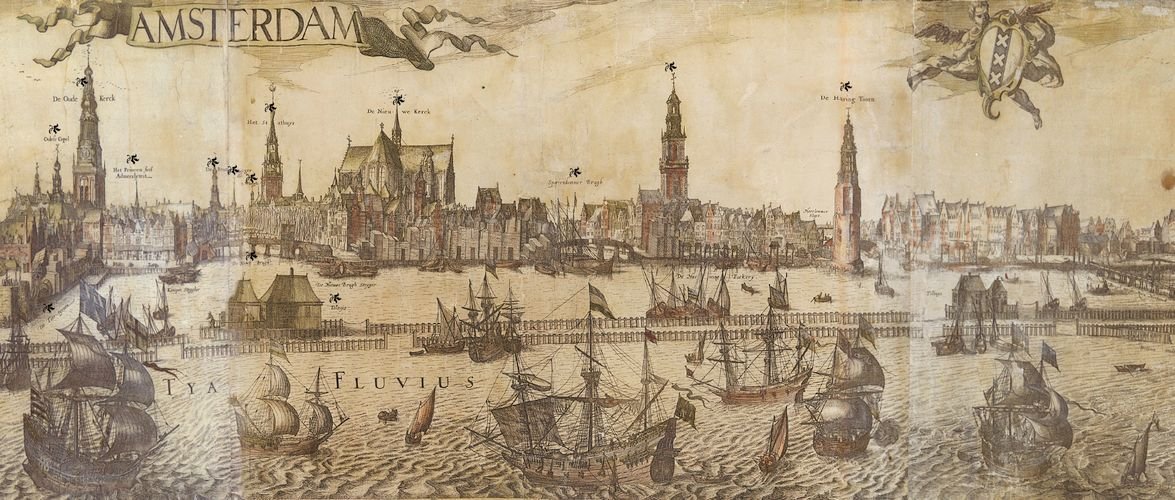
When fictional physician Alexander Baxby arrived from England with his friends in 1608, the River Ij estuary would have teamed with ships converging on the busy port. A long row of masts stretched along the busy harbourfront, with the twisted onion spire of the Oude Kerk (Old Church) rising behind. Goods were unloaded at the quay, weighed and sold in Dam Square, then reloaded on to smaller boats for crossing inland waterways, with unprecedented efficiency. The city was home to the world’s first stock exchange, and headquarters of the East and West India Companies. A single shipment of spices could make investors rich. After the Dutch Republic and Spain signed the Twelve Years’ Truce in 1609, merchants were free to exploit more trade routes, bringing further prosperity.
Amsterdam’s growing and increasingly wealthy middle-class bought elegant brick canal houses, which gradually replaced the city’s older wooden ones, and commissioned art to adorn their walls. The resulting Dutch Masters style of painting provides a window into their world. Rembrandt moved to Amsterdam because of the burgeoning market there and painted his famous Night Watch whilst living in the city. Whereas earlier artists had been constrained by upper class tastes, now they depicted the lives and interests of increasingly confident ‘middling folk’. The paintings show their pride in their families, interior design and fashion choices, similar to the way some people share personal images on social media today. It was fascinating to imagine burghers, guildsmen and their wives wearing the enormous ruffs and playing intricate musical instruments, also wondering how difficult it must have been to keep their perfect chequered floor tiles clean. Other paintings depict contemporary agriculture, industry, trade and political life, all combining to provide a rich resource for authors like me.
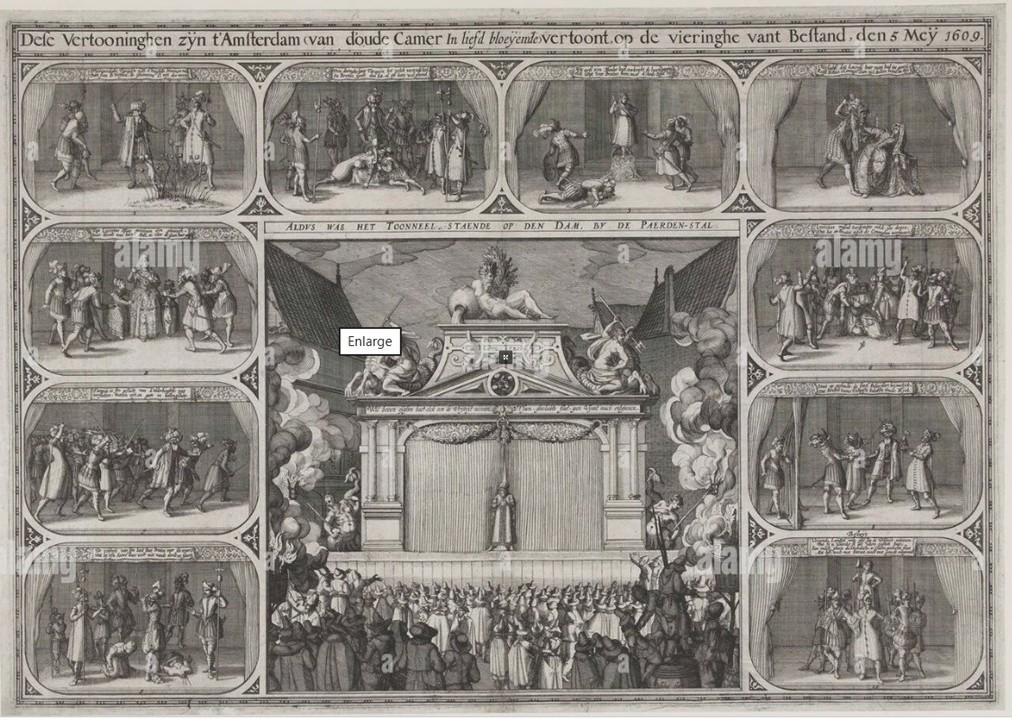
A different type of image helped me understand Amsterdam more, one resembling a movie story-board. I felt sure the city authorities would have wanted to organise a local celebration to mark the signing of the Twelve Years’ Truce with Spain, and eventually found a picture, detailing the play they staged in Dam Square. The central image shows smart citizens, in capotain (often called pilgrim) hats, bonnets and cloaks, clustering round an enormous stage adorned with sculptures of Roman gods. The outer images capture scenes from the dramatised life of Lucius Tarquinius Superbus, the last king of Rome. This choice suggests the city saw itself as establishing a new age, similar in significance to the dawn of the Roman Republic. Nevertheless, Tarquinius’ life must have been a lurid spectacle, with brutal portrayals of patricide, kidnap, rape, and suicide. Clearly, Amsterdam’s Reformed Protestants were not as austere and prudish as they, and their English Puritans counterparts, are often portrayed.
Fortunately, there are also beautiful illustrated maps from the time, which capture the layout of the city at intervals. Unlike the City of London, where much of the Tudor street pattern remains, Amsterdam changed many times as it grew, with land being reclaimed from marshes, only to later be filled to form streets. Sadly, Amsterdam Central Station was built on the site of the old harbourfront, so that can no longer be seen. A 1570s map shows the tulip-shaped medieval city, divided into old and new parts, and the walls surrounded by the Singel and Kloveniersburgwal canals which acted as a moat. By the 1650s map, the city had expanded, with the additional of a new outer line of bastion walls, and the concentric rings of canals which give the modern city its distinctive appeal. Neither historical map shows the pattern of development in the intervening years. I am indebted to Geert Mark, whose book Amsterdam, A Brief Life includes the layout of the four overcrowded islands where Baxby’s Separatist friends and other immigrants lived, between wharves, warehouses and industrial sites.